Gesture Drawing: A Practical Guide for Beginners
Gesture drawing is a quick sketch, usually 30 seconds to 2 minutes, that captures the movement and energy of a pose rather than its details. You start with one flowing line through the body, called the line of action, then add the main masses of the head, ribcage and pelvis. Practiced daily with timed reference poses, it is one of the fastest ways to make figure drawings look alive.
Last updated November 5, 2026
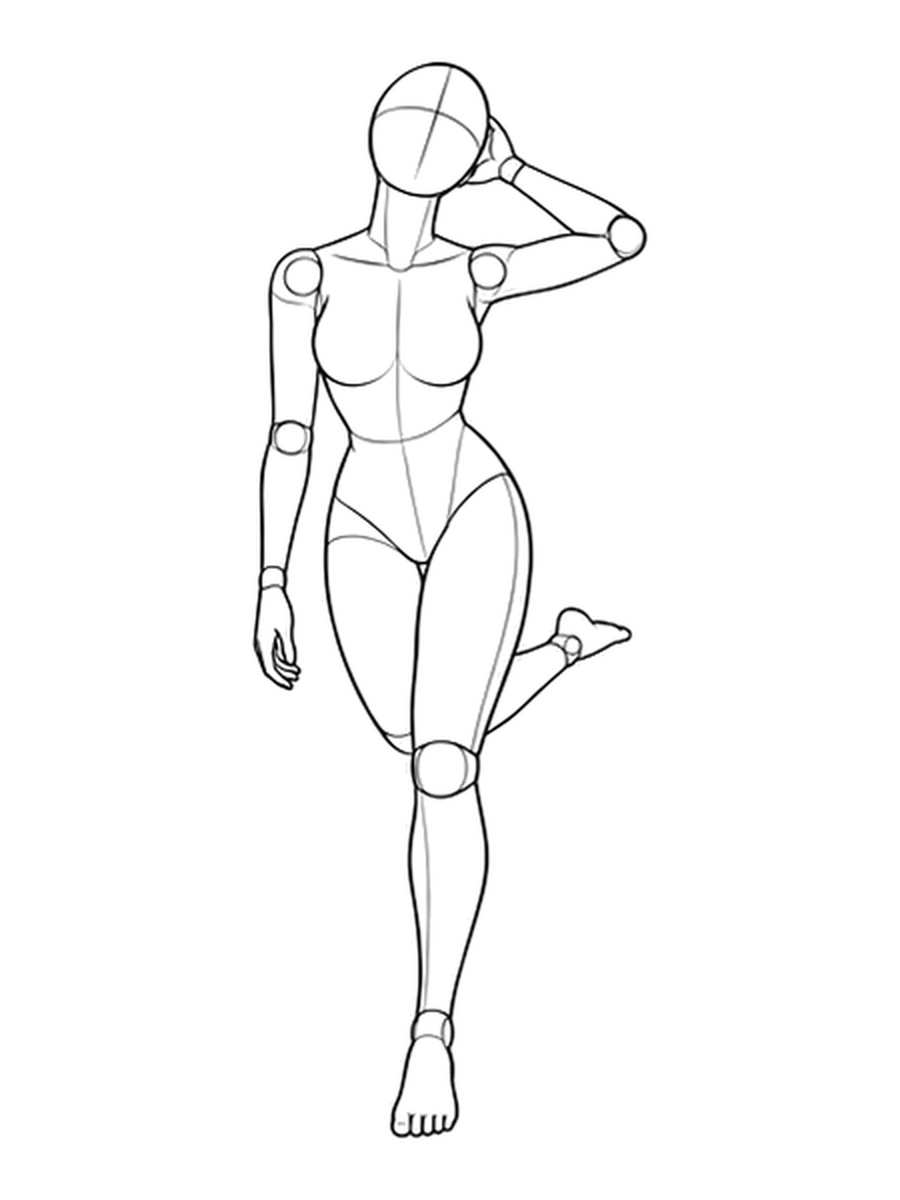
A two-minute gesture drawing exercise for beginners
- First 30 seconds. Find the planted foot. Draw a sweep from the tilted head through the torso to that foot, then mark the lifted heel.
- Next 60 seconds. Place the shoulders and hips across your line. Add the lifted elbow and bent knee. Leave the blank spaces between the limbs and torso open.
- Last 30 seconds. Cover the reference. Can you tell which leg holds the weight? Uncover it and compare the position of the head over the planted foot. Move one landmark and stop.
Compare every P024 camera angle for a second drawing. Check how far the raised heel sits behind the hip in the side view.
What is gesture drawing?
Gesture drawing is about the big idea of a pose: where the weight sits, which way the body leans, and how the parts connect. It ignores fingers, faces and clothing on purpose. Because each drawing is so short, you learn to see the whole figure at once instead of copying it piece by piece. That habit carries over into longer drawings, character design and animation.
Why practice gesture drawing
- It trains you to see rhythm and balance, so stiff figures start to look natural.
- It builds speed and confidence, because you stop being afraid of a bad line.
- It gives you a library of poses in your head that you can use later without reference.
- It is a perfect warm-up: ten minutes before a longer drawing session loosens your hand.
Gesture drawing step by step
- Find the line of action. Look at the whole pose for a few seconds and find the main curve that runs from the head through the spine to the weight-bearing foot. Draw it in one stroke.
- Place the head, ribcage and pelvis. Hang three simple shapes on that line: an oval for the head, an egg for the ribcage and a smaller box or bowl for the pelvis. Notice how the ribcage and pelvis tilt against each other.
- Add the limbs as simple lines. Use one or two strokes per arm and leg. Show where they bend, not what they look like.
- Check the weight. Make sure the weight-bearing foot sits under the center of the body, or the figure will look like it is falling.
- Stop when the time is up. The point is to capture the gesture, not to finish the drawing.
How long should each pose be?
A common session uses a mix of timings:
| Timing | Number of poses | Focus |
|---|---|---|
| 30 seconds | 10 | Line of action only |
| 1 minute | 5 | Line of action + head, ribcage, pelvis |
| 2 minutes | 3 | Add limbs and weight |
| 5 minutes | 1–2 | Refine proportions while keeping the energy |
About 20 minutes in total is enough for a daily routine.
Common gesture drawing mistakes
- Drawing outlines instead of movement. Tracing the contour makes the figure stiff. Draw through the body instead.
- Starting with the head and adding details. Leave the face and hands for longer drawings.
- Straight, symmetrical lines. Real bodies are made of curves and opposing angles. If both shoulders are level and both legs are straight, look again.
- Using too many strokes. Fewer, confident lines read better than many hesitant ones.
Where to find gesture drawing reference
Use reference poses that show the full body clearly, ideally on a plain background, from several angles. LewdPose's dynamic poses are good for practicing strong lines of action, while male and female poses help with everyday weight and balance. Need more ideas? Browse every category in poses for drawing, including anime poses, couple poses, sitting poses, hand poses and action poses, or describe a pose and create it with the AI pose generator.
Standing and looking up
MaleThree-quarter view
Stretching both arms overhead
FemaleThree-quarter view
Hurdle jump
DynamicLow angle view
Standing and looking up
MaleSide view
Stretching both arms overhead
FemaleSide view
Hurdle jump
DynamicSide view
Standing and looking up
MaleFront view
Stretching both arms overhead
FemaleFront view
Hurdle jump
DynamicFront view
Carrying a box on one shoulder
MaleThree-quarter view
Crouching to pick something up from the floor
FemaleThree-quarter view
Fighting guard stance
DynamicLow angle view
A 7-day gesture drawing plan
- Day 1: 20 × 30-second poses, line of action only.
- Day 2: 10 × 1-minute poses, add the head, ribcage and pelvis.
- Day 3: Dynamic poses only, 10 × 1 minute.
- Day 4: Same pose from front, side and three-quarter views, 2 minutes each.
- Day 5: Sitting and crouching poses, focus on weight.
- Day 6: Draw 5 poses from memory, then compare with the reference.
- Day 7: Mixed session with all timings.
Questions about gesture drawing
Give your pose idea a character.
Use the position, camera angle and composition to write your prompt. The image and video studios provide separate creation workflows.